On Wednesday, the United Nations passed a resolution recognizing the transatlantic slave trade as “the gravest crime against humanity.” The resolution was started by Ghana’s president John Mahama who rallied the world to ratify a landmark vote against the transatlantic slave trade. The decision has been welcomed throughout Africa. It is believed that over 15 million people were deported from the continent, moved across the globe and enslaved in totally inhumane conditions for over 4 centuries. Some question the numbers: how could the transatlantic slave trade show numbers like 15 millions over 4 centuries when we all know that a ship carried about 250 to 400 people, and that at the height of the trade, 30,000 people per year were taken from Elmina castle alone (Reclaiming African History: Elmina Castle – West Africa’s Oldest Slave Fort), that’s 3 million people in one century from Elmina alone; now do the math, and add all the other slave forts across Africa! … you would agree that the math is not math-ing. And to think that it took so long to be recognized! Now that it is recognized, what does this mean? Is it just an empty “we recognize the wrong we did to you…” and nothing else?
Slave capture
By the way, guess which countries voted against the resolution? Argentina, Israel, and the USA. Guess who abstained? Most European countries!
… On Wednesday, less than two years after completing a remarkable comeback as Ghana’s president…, [John Mahama] rallied the world to ratify a landmark vote against transatlantic chattel slavery, despite major opposition from the same western entities that drove it for centuries.
The resolution to declare the practice as “the gravest crime against humanity” passed with a decisive majority at the UN general assembly and has been largely welcomed across Africa. Yet the details of the tally reveal a world still deeply divided on the gravity of the sin of enslaving more than 15 million people as chattel over the course of 400 years.
Inner courtyard at Elmina Castle (Source: Ghana.nl)
Thus, the 123 states who voted for it were just as noteworthy as those that did not. Most of the assembly was in support including Africa, Asia, the Caribbean, most of Latin America, all former victims, as well as the Arab world, who themselves have the dark history of trans-Saharan slavery under their belt. Russia called it a “long overdue recognition”.
Perhaps because of their history of subjugation of Indigenous people and perpetuation of chattel slavery, the western bloc of Australia, Canada, the UK and the EU states all abstained in the vote, electing to postpone their day of atonement.
The three states to publicly vote against the resolution were Argentina, where two-thirds of the value of all imports arriving at the port of Buenos Aires between 1580 and 1640 were enslaved Africans; Israel and the US, where 11 states seceded rather than obey the Emancipation Proclamation freeing enslaved Africans.
Today, we will continue our discussion on “How Puppet Regimes are Built.” We will focus on African regimes, particularly those installed in Francophone Africa, regimes inherited from the colonial era. We all remember how King Behanzin, Prempeh I, Samori Toure, and countless others were replaced by docile and easy to manipulate puppets serving France. This is still ongoing, and can explain those ridiculous laws or rules, or even election numbers made by these horrible puppets today: Sassou Nguesso, Paul Biya, Alassane Ouattara, to name just a few. Given that their authorities are not based on the sacred laws of the countries, but are rather backed by foreign powers and their guns, they do not fear to strangle their people for decades. A century later, the modus operandi of the puppets installed yesterday during slavery times and today during ‘independence’ has not changed
“Quand l’Africain était l’or noir de l’Europe” de Bwemba Bong
Below are the consequences of building puppet regimes, as detailed by Pr. Bwemba Bong in his book “Quand l’Africain était l’or noir de l’Europe. L’Afrique: Actrice ou Victime de la Traite des Noirs? – Démontage des mensonges et de la falsification de l’histoire de l’hydre des razzias négrières transatlantiques” (When the African was the black gold of Europe. Africa: Actress or Victim of the Slave Trade ? – Dismantling the lies and falsification of the hydra history of the transatlantic Slave Raids),” MedouNeter 2022, p. 170 (translated to English by Dr. Y, Afrolegends.com). In his section titled “The transformation of the administrators of the so-called French-speaking colonial Black Africa into anti-African, ethnic ogres and terrorists”, he explains so well :
… The slave-trading origins of the power held by “African political leaders” have entailed three notable consequences:
It has undermined the sacred foundations of authority in Black Africa, for that authority “ceases to derive its legitimacy from a reference to ancient sacred procedures. It no longer appears to have received its sole consecration from the Ancestors, from divinities, or from the ritual forces associated with every manifestation of authority. This phenomenon is further accentuated by the fact that missionary activity creates a religious diversity that fractures the spiritual unity of which the sovereign or the chiefs serve as symbols. At the same time, it contributes to a secularization of authority,” writes Georges Balandier [in Le contexte sociologique de la vie politique en Afrique noire, dans Revue française de science politique, 1959, p.604-605].
Traditional checks and balances have been destroyed: the Council of Elders, in particular, vanished due to the control exerted by European slave traders. Consequently, punishable abuses—even those that were effectively sanctioned—were no longer, and are no longer, curbed in accordance with the interests of the group. Georges Balandier characterizes this phenomenon as a “rupture of traditional systems for limiting power,” a rupture he describes in these terms: “sovereigns wield a more arbitrary power, albeit one that is more circumscribed, and the consolidation of power matters more than the acquiescence of the governed. The latter, conversely, may attempt to appeal to the foreign administration in order to oppose certain decisions made by traditional authorities. On both sides, the relationship is distorted, and mutual obligations no longer appear clearly defined.”
By the grace of the occupying power, delinquent slave-broker intermediaries [western puppets in Africa] had become, and remain to this day, the replacements for legitimate traditional authorities. This status, bolstered by the perverted prerogatives inherited from their European creators, enabled them then, as it does now, to assume the responsibilities of tax collectors, census takers, administrators, and the like. It also empowered these “chiefs” to requisition populations for forced labor, the construction of bridges and roads, and other such tasks. The overwhelming majority of these “chiefs” were remunerated by the slave system in their capacity as public agents.
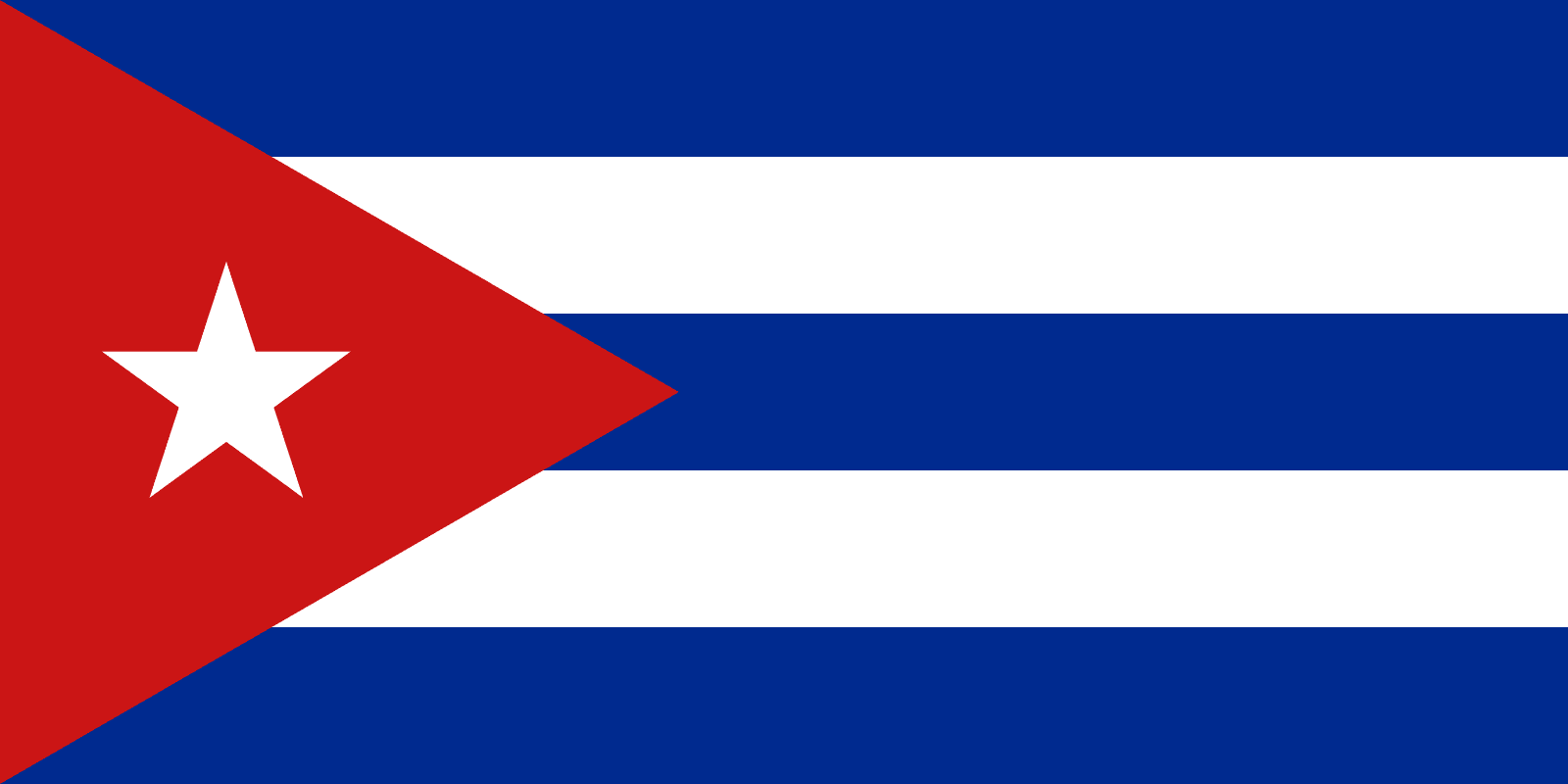
Our hearts go out to our Cuban brothers and sisters who are currently getting strangled alive! Yes… alive! Through no fault of their own, except standing for their freedom. Cuba has been struggling, facing embargo for over 64 years (the US imposed embargo on Cuba on February 3, 1962), and now, since January 3rd when the US kidnapped the Venezuelan president Nicolas Maduro and his wife (Pirates of the Caribbeans in Venezuela, or the Renewed Face of the Far West), Cuba has been denied any oil imports. Until then, Venezuela had been providing 50 % of all of Cuba’s oil. Since then, all other countries, like Mexico, which were providing oil to Cuba have stopped after getting threatened by American president Donald Trump with tariffs. On Monday, the power grid collapsed, and on Wednesday power was partially restored to the island of 11 millions. Faced with years of embargo, Cuba’s power grid is aging and now with the recent oil blocade, it is falling apart. Highways are deserted, hospitals suffer, doctors operate with candle lights, and mothers give birth in darkness.
Whatever happens, Cuba is a beacon to the ‘small’ people of the world, and we stand with them. Cubans with Fidel Castro (Fidel Castro: Ideas cannot be Killed!) have shown us that the size of a country or its people does not matter when fighting for freedom and principles. Cuba is a small country, but its actions, its help, has been immense to Africa for the past 50 years. Even to this day, doctors across Africa have been trained in Cuba, and Cuban doctors have vastly supported the health-care services of many countries including Ghana. We stand with them!
Cuba has reconnected its power grid and brought online its largest oil-fired power plant, energy officials said, putting an end to a nationwide blackout that lasted more than 29 hours amid a United States move to choke off the island’s fuel supply.
After the country’s 10 million people had been plunged into darkness overnight, the Caribbean island’s national power grid had fully come back online by 6:11pm (22:11 GMT) on Tuesday. However, officials said power shortages may continue because not enough electricity is being generated.
In addition to cutting off oil sales to Cuba, US President Donald Trump has escalated his rhetoric against the Communist-run island, saying on Monday he could do anything he wanted with the country.
A US State Department official blamed the Cuban government for the grid collapse, calling blackouts a “symptom of the failing regime’s incompetence”.
Cuban President Miguel Diaz-Canel fired back at Washington, criticising its “almost daily public threats against Cuba”.
“They intend to and announce plans to take over the country, its resources, its properties, and even the very economy they seek to suffocate in order to force us to surrender,” Diaz-Canel wrote on social media on Tuesday night, shortly after power returned nationwide.
Cuba has yet to say what caused Monday’s nationwide grid failure, the first such collapse since the US cut off the island’s oil supply from Venezuela and threatened to slap tariffs on countries that ship fuel to the nation.
By midday on Tuesday, grid workers successfully fired up the Antonio Guiteras power plant, a decades-old behemoth that underpins the country’s power grid.
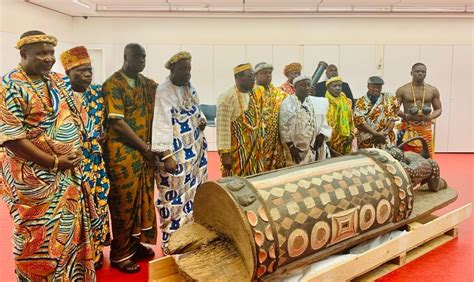
Tchaman (Atchan) Kings and dignitaries in front of the Djidji Ajokwe talking drum (Source: Afrikmonde.com)
On this day, France has returned a sacred drum looted from Côte d’Ivoire after 110 years. It was taken from the Tchaman (Atchan, Ebriés) people by the French people. The sacred, talking drum, is known as the Djidji Ayôkwé and was exposed at the Musée du Quai Branly. The drum is 4 m (13 ft) long and 430 kg (948 lbs) heavy. This is the first object returned by France to Côte d’Ivoire, the first of 148 artifacts.
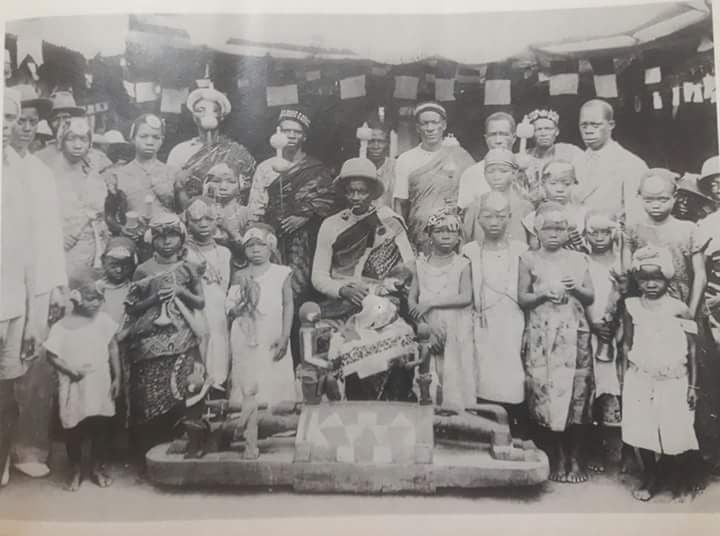
Tchaman (Ebrié) King, Nandjui Abrogoua and his court (1848 – 1938) – Foreground : “DJIDJI AYOKWE” the sacred talking drum of the Tchamans (Ebriés) of Goto Bidjan. (Source: Photo/IT / TheAfricanDream.net)
France returned a sacred drum that was taken from the Ivory Coast during colonial rule at a ceremony in Abidjan on Friday, marking the first official restitution of a cultural artefact from France to the West African country.
The Djidji Ayôkwé, described as the “talking drum,” is a massive carved wooden drum once used by the Atchan people of the Abidjan region to communicate between villages. It landed in the economic capital early Friday morning.
… It is expected to go on display in April at the newly renovated Museum of Civilizations in Abidjan.
“Your return is a message for our young people who have decided to take ownership of their history, for the communities that are rediscovering their Djidji Ayôkwé, a symbol of social cohesion, peace and dialogue,” Ivory Coast’s culture minister, Françoise Remarck, said during the ceremony.
Seized by French colonial authorities in 1916, the Djidji Ayôkwé had been among 148 objects formally requested by the Ivory Coast from France in 2018.
“This drum has been gone for centuries, so today, as a young man, I am overjoyed to receive it and to see it,” said Serge Akmel, who came to watch the arrival.
“When this drum was taken, it was difficult for us; they took something heavy from us. Today, we received the drum.”
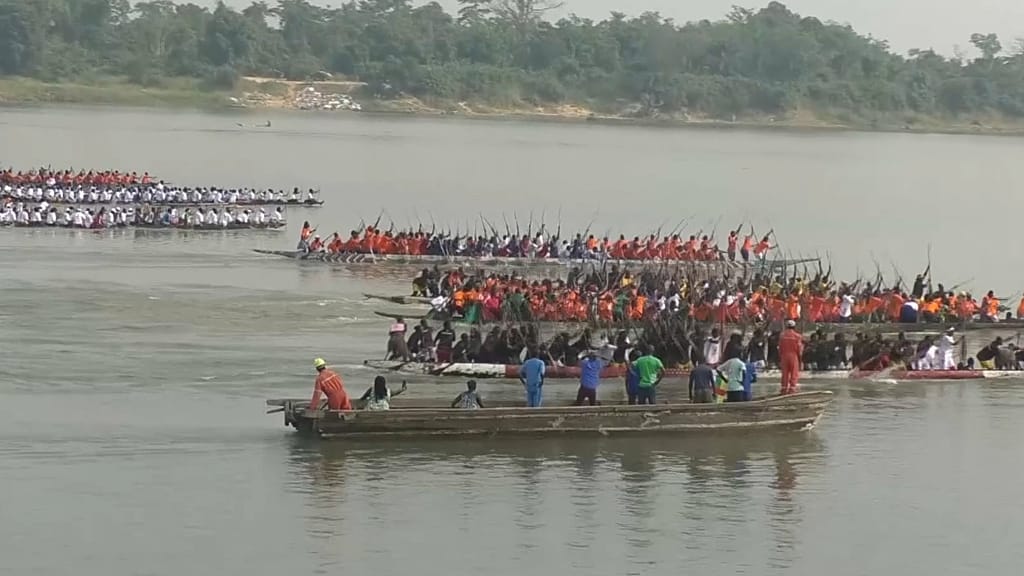
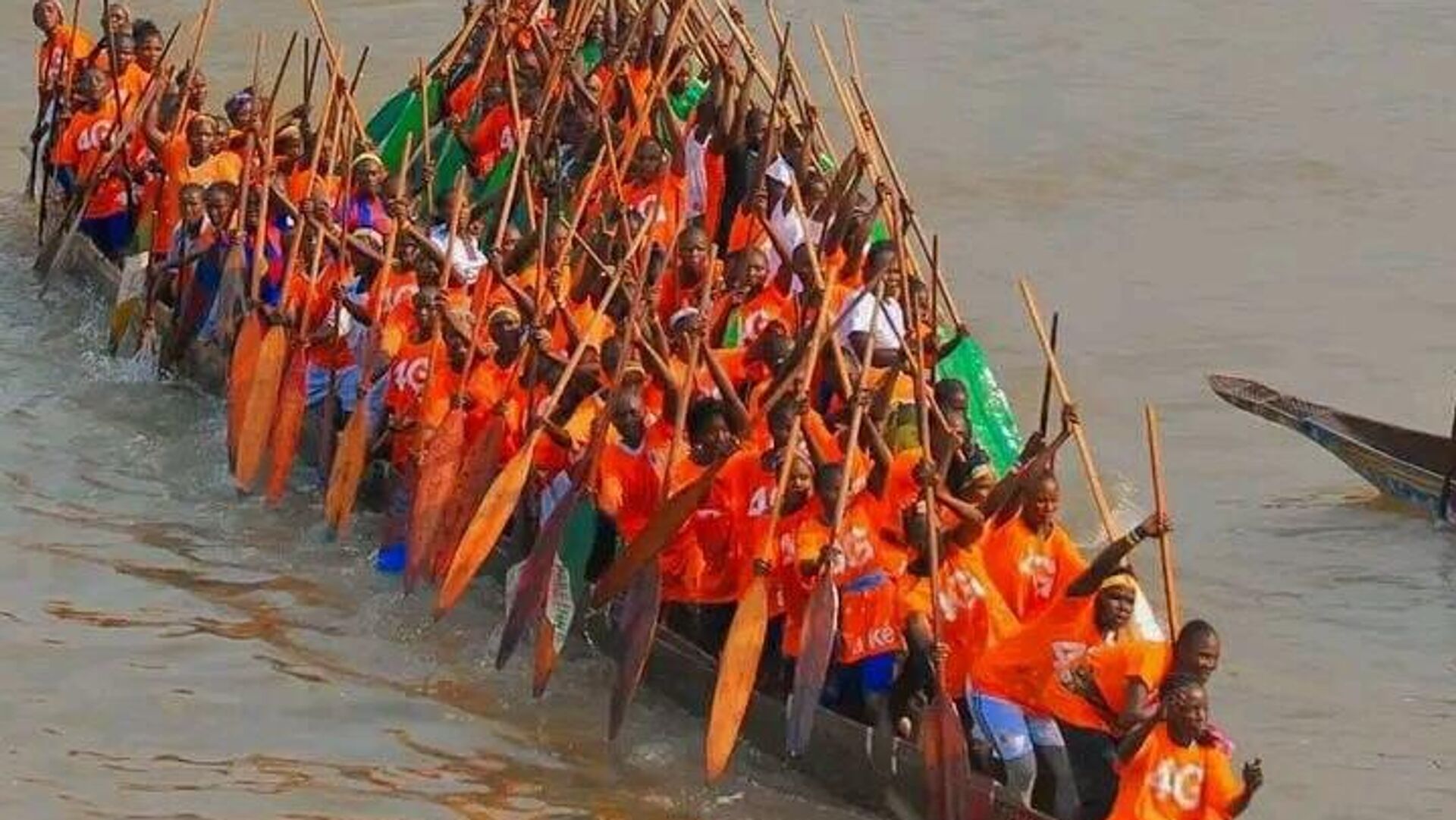
Women in a rowing competition on the shores of the Ubangi River in Bangui (Source: Africanews)
For the International Women’s Day (IWD) this year, the women of the Central African Republic (CAR) decided to have a rowing competition in the capital Bangui, as opposed to the usual parade. I thought the idea sweet, and wanted to share. The competition took place on March 8, 2026, on the shores of the Ubangi River in Bangui. The ladies of Bangui came out in droves and participated in a 100% rowing feminine competition. In our countries, rowing competitions are usually male, rarely do we have a female competition; this might be a first! Imagine the togetherness spirit these women showed, the courage, and the fun! And the men came out to cheer the women in the race; there were thousands of spectators. This is an inspiration to other women in the country, on the continent, and around the globe, how about making IWD an action day?
Women celebrating IWD by rowing in a 100% female competition in Bangui (Source: Africanews)
The women of Bangui, the capital of the Central African Republic, responded enthusiastically to the call from the organizers of the all-female canoe race on the Ubangi River.
In a frenzied atmosphere, the women flexed their muscles, paddling in long canoes. This year in Bangui, they wanted to celebrate International Women’s Day in a different way. Along the riverbank, a roaring crowd cheered the arrival of the winners.
“You know, it’s usually our husbands who do the races, but for this day, we thought, why not us! We are just as capable as our husbands, and we are proud of it. I am very happy that my village, Bokassi 1, was able to take first place in this race,” declared Jupsie Mameleyabi, captain of the Bokassi women’s team.
… “I am very proud to have participated in this race. I witnessed the bravery of Central African women and girls; they were courageous, committed, and determined, and that is what March 8th is all about. March 8th is about celebrating women’s victories and their commitment, and they demonstrated that this afternoon. So, congratulations to the Central African Republic for winning, and congratulations to the women and girls of the Central African Republic. Rights, justice, and action for all the women and girls of the Central African Republic,” explains Rachel Miam Diagone, UN Women Resident Representative in the Central African Republic.
Since last Saturday, we have been witness to joint Israeli-US attacks on Iran, which killed the Supreme Leader of the Islamic Republic of Iran, over 100 little girls, and others. At the beginning of the week, the US also engaged in a joint military effort with Ecuador against narcotrafics in Ecuador and carried out air strikes. We also know about the deployment of some 200 American troops in Nigeria. Yesterday, the American president announced that Cuba would be next. Brothers and sisters… there is no letting up! To each one of us, this is a signal to stay alert!
Flag of Venezuela
As it stands now, what the US has done with the blatant removal of Nicolas Maduro in Venezuela, and now the murder of the Ayatollah Khamenei in Iran (during Ramadan) has united the people of the global South in general and Muslims of all board in particular, against the United States. How long can a giant stay (over)stretched? The people of Iran are fighting for survival… while the United States are fighting to help a friend (Israel)… there is a difference! The geology of the Iranian territory makes it an almost impenetrable fortress. Remember that this is the same Iran which fought tirelessly against Iraq’s Western-backed invasion. Why does the West think that it is okay to decide for the people of a country? Why not let them decide for themselves: throw out whoever they want whenever they want without western intervention? Wouldn’t it be arrogant to want to change their condition without their participation?Who is to say what is good! We all know Western media lied about Muammar Gaddafi in Libya, claiming he was killing his own people, and that the Libyan people needed democracy… look what is left of Libya now! Is there one Libyan out there (except puppets) who can look at their country now and applaud the NATO attacks?
We will note that, as always, the West cannot be trusted. Iran was at the table of negotiations on Friday and got bombed the next day! This is so reminiscent of so many situations in the world: the recent DRC-Rwanda peace agreement treaty where the country is still occupied and attacked by Rwandan-backed M23, and countless others. Would you blame Iran for not wanting to sit at a negotiation table?
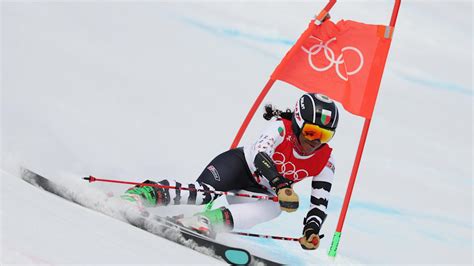
The 2026 Winter Olympics took place in Milan and Cortina, Italy this year, last month. The African participation at these Winter Olympics reached a historic high, with 15 athletes representing 8 African nations, competing across multiple winter sports. After PyeongChang 2018, this is the second time in the history of Winter Olympics that Africa is set to be represented by 8 countries. This marked the highest show from the continent at a Winter Game, reflecting steady growth in representation and investment in winter-sport pathways.
Mialitiana Clerc (Source: Olympics.org)
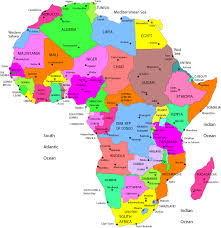
The 8 countries were Benin, Guinea-Bissau, Nigeria, Eritrea, Madagascar, Morocco, Kenya, and South Africa. Benin and Guinea-Bissau had their debut appearance. South Africa fielded its largest-ever Winter Olympic team, with 5 athletes. These 8 countries were represented by 15 athletes competing in alpine skiing, cross-country skiing, skeleton, and other individual disciplines. Mialitiana Clerc represented Madagascar, becoming the first African woman to compete in three winter olympics.
Map of Africa
The athletes were Nathan Tchibozo of Benin and Winston Tang of Guinea-Bissau giving their country’s first time participation at the Olympics in Alpine Skiing, Samuel Ikpefan of Nigeria in Cross country skiing, Shannon-Ogbnai Abeda from Eritrea in Alpine skiing, Mialitiana Clerc and Mathieu Gravier from Madagascar in Alpine Skiing, Pietro Tranchina competing in alpine skiing and Abderrahim Kemmissa in cross-country skiing both from Morocco, Issa Laborde from Kenya in Alpine skiing; Lara Markthaler in alpine skiing, MalicaMalherbe in freestyle skiing, Matthew Smith in cross country skiing, Nicole Berger in skeleton, and ThomasWeir in alpine skiing all representing South Africa.
There were no medals, but we are very proud of these athletes who showed great courage and resilience and patriotism to represent their countries.
As a side note, I would like to give a shout out to an American junior cousin duo skating pair whose parents are originally from Benin, formed by Anaelle Kouevi and Yann Homawoo. They are a rising US junior ice dance team; they won the US Novice Bronze medallists in 2024, and have not yet participated at the Olympics. They show great promise and we are also proud of them.












 African Heritage